Book Reviewed:
John G. Turner: They Knew They Were Pilgrims: Plymouth Colony and The Contest for American Liberty, Yale University Press, 2020. 464 pp, $15.74. Kindle version.
A book published in 2020 by John G. Turner, Chair Professor of Religious Studies at George Mason University in Fairfax, Virginia, author of The Mormon Jesus: A Biography (Harvard University Press, 2016), Brigham Young: Pioneer Prophet (Harvard University Press, 2014), and Bill Bright and Campus Crusade for Christ: The Renewal of Evangelicalism in Postwar America (The University of North Carolina Press, 2008), which won him the 2009 “Christianity Today” Book Award for best History/Biography.[1] Professor John G. Turner researches and teaches Mormonism, evangelicalism, and seventeen-century puritanism, as his page on the George Mason University website tells us.[2] He belongs to the Burke Presbyterian Church, he came of age in two “evangelical parachurch organizations, namely Young Life and InterVarsity Christian Fellowship, as his own website informs us, and he wanted to “understand the institutions and personalities that had shaped” his “own religious culture.”[3]
His most recent book, They Knew They Were Pilgrims: Plymouth Colony and The Contest for American Liberty, written in a very pleasant, easy to read, style, has an Introduction, nineteen chapters, a Conclusion, a List of Abbreviations, Notes and Index, besides the Acknowledgements and Notes on the text, which come first. The chapters are ordered chronologically, and the author parallels the events in the colonies with those in Britain, in order to explain what happened on both sides of the Atlantic and put things in relation to one another.
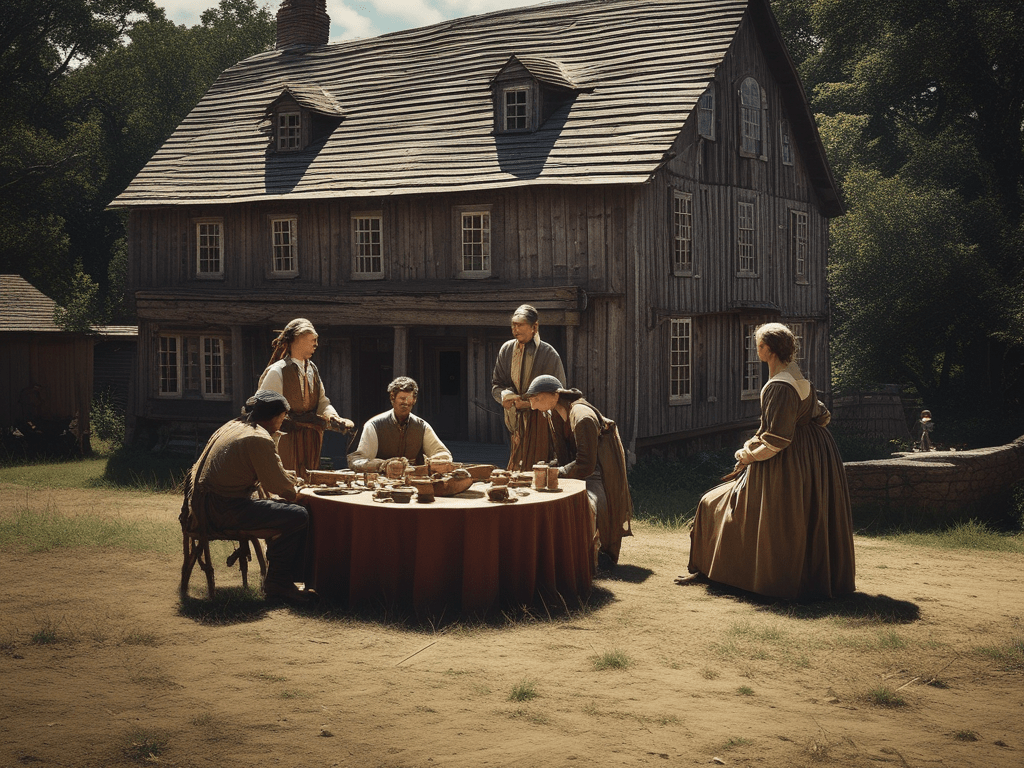
This is a book about the first English colonists of New England, Plymouth Colony at the time, situated in the Eastern part of today’s United States. A book about the notion of liberty as it was understood in the 1620s-1690s, about the religious conflicts and the colonists’ first steps towards using and selling slaves, mostly Native Americans and less Africans, in those times and in that area. My expertise being only in African-American slavery, I was surprised to see the same treatment applied by the English to the Native population, and precisely in that area which was going to host the Liberator abolitionist newspaper in the nineteenth century, published by the famous white William Lloyd Garisson, in Boston, between 1831-1865.
Yet liberty, for the very religious English of those times, was not very much connected with our liberty, today. They had left England for Leiden, in the Netherlands, to be able to keep their religious liberty, understood in opposition towards the Anglican Church: they contested, for instance, the use of the Bible during prayers, the mass based on the Book of Common Prayers, or the use of the cross at baptism. For them, the Catholic Church meant the Antichrist, and their life needed to follow the Holy Scripture completely. They were called, therefore, separatist Puritans, the most radical, or protestants of the Protestants. They chose America as their destination only when the situation in the Netherlands also became intolerable. Yet, not all dared to start such a trip over the Ocean. Those who did have the courage, helped by an English merchant and smuggler, who managed to gather a group of investors around him to finance their trip, and to whom the pilgrims established at Plymouth remained indebted for a long time, were advised by the pastor remained in Leiden not to be tolerant or open minded, but to “test any idea against the firm rule of scripture” (45). He warned them “against self-satisfaction,” because, he said, “even true churches, those that resembled heaven on earth, fell short of the purity and perfection revealed in the Bible” (45). And this remained their only understanding of the notion of liberty, the liberty of consciousness, as long as this colony lasted. Thus, they neither avoided, nor opposed the idea and the practice of using slaves in their new homes, or of turning other populations into slaves.
Speaking of taking Native Americans into slavery, the book tells us that English officers were motivated by a mixture of revenge and greed when they took more than three hundred Pequot Indians, mostly noncombatants, “as the spoils of war”:
“For example, militia captain Israel Stoughton sent about fifty Pequot women and children to Boston. He asked to have the “fairest and largest” woman for himself. Bay Colony magistrates distributed or sold the rest. When some Pequots taken to Boston escaped, Native allies of the English recaptured them. Massachusetts officials then branded the runaways on the shoulder. Some captives ended up thousands of miles from their homes” (171).
The Governor of Providence Island referred to the Pequot captives as “cannibal Negroes from New England” (171). At the same time, however, England took pride on not having slaves on its territory. Quite erroneously, as John Turner explains us, since the merchants and other English men, “often retained African slaves as their property after keeping them in England for many years” (171), where kidnapped Natives also ended up. And yet, the British had to boast about something when they criticized their rival powers: Spain, Russia, or the Ottoman Empire. But they saw no problem in having those slaves in the colonies, since, as English explorers and merchants could see, either in Russia or in Java, slavery was as valid.
The Bible, in its turn, offered them arguments supporting the taking of defeated populations in slavery. And so did the philosophers and law theoreticians, from Aristotle to Grotius: “In a just war, or at least in a properly declared war, it was permissible to enslave one’s opponents, which was at any rate more merciful than killing them. Accordingly, European powers enslaved prisoners during wartime” (172).
And yet, the author argues, the winners did not generally enslaved “noncombatants en masse” (172) at the end of intra-European wars. As for the English, they perceived “other peoples as more fit for servitude and slavery” (172). In the wars against British rule in Ireland, the English sent thousands of men, women and children to the colonies in the Caribbean Islands or to those in North America. For the already established English people in New England, slavery was “a fitting punishment for Native peoples who fought against them” (172). A punishment with an economic value—captive Natives were both workers and “commodities who could be sold in the marketplace or exported to the Caribbean” (172). A few years after the Pequot War, Massachusetts Colony would turn the enslavement of war prisoners into law: “There shall never be,” magistrates declared, “any bond-slavery, villeinage and captivity amongst us; unless it be lawful captives, taken in just wars, and such strangers as willingly sell themselves, or are sold to us” (172). The law covered, thus, both Native and African slaves.
Later on, in the years 1675-78, after yet another great war between Natives and the English, King Philip’s War, caused by the same lack of obedience on the part of some of the tribes and the continuous desire of domination and control on the part of the English, manifested even by letting the cattle ruin the cultivated Indian lands, we are told, “As many as one in every ten adult English men died or suffered captivity, and dozens of English women and children perished” (296). And yet, Natives’ losses were far worse: “many thousands were gone, killed on the battlefield, dead of disease and hunger, living as refugees to the west or north, or transported as slaves out of New England” (296). As a result, their population dropped by half.
What should we remain with, as a memory of this famous first American colony, if we put the myths of republicanism, democracy and religious tolerance aside? In author John Turner’s vision, what the pilgrims and the other inhabitants of the colony arrived with subsequent occasions and shipments across the Ocean “left behind” is “both a complicated legacy of human bondage and unresolved debates about liberty” (366).
[1] See https://uncpress.org/book/9780807858738/bill-bright-and-campus-crusade-for-christ/
 Home | Discussing Slavery: Conferences, articles, book reviews
Leave a comment