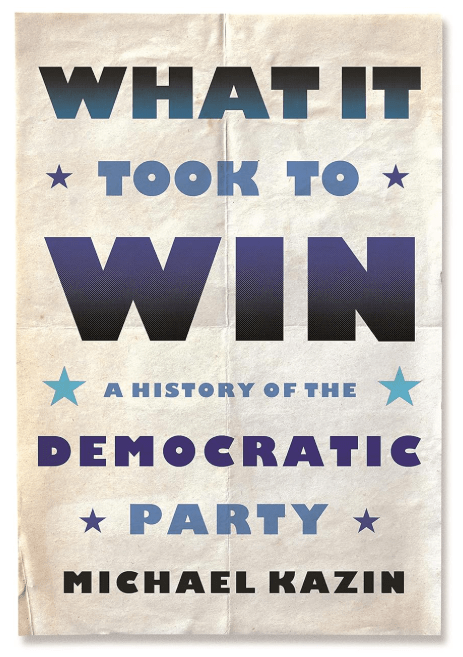
A great book on politics, What It Took to Win. A History of the Democratic Party was published by Michael Kazin, a party sympathizer all his life, professor of history at Georgetown University, editor emeritus at Dissent, co-editor of the Princeton Encyclopedia of American Political History and author of several books: War Against War: The American Fight for Peace, 1914-1918 (2017), American Dreamers: How the Left Changed a Nation (2011), The Populist Persuasion: An American History (2017), and A Godly Hero: The Life of William Jennings Brian (2006).
The book has a “Dedication,” a “Preface: To Promote the General Welfare,” a “Prologue: A Useful Myth,” nine chapters with subchapters, a “Photographs” section, an “Appendix,” “Notes,” “Good Reading,” “Acknowledgements,” and an “Index.”
Easy to read even by those not specialized in political studies, What It Took to Win explores the principles that stood at the basis of creating the Democratic Party in the first half of the nineteenth century, the party’s mistakes, internal conflicts, its gains and losses since the beginning until Joe Biden’s presidency.
The “Preface” introduces us to the negative sides of nineteenth-century Democrats, who “carried out the forced removal of Native Americans from their ancestral lands, defended slavery and allowed it to expand, did their best to sabotage Reconstruction, and constructed the brutal Jim Crow order that followed. They also lagged behind Republicans in endorsing women’s suffrage. Not until the 1930s did the party, at the national level, begin, tentatively, to embrace interracial constituency” (loc. 55).
Then, one key term follows, namely the “moral capitalism,” first described as “programs designed to make life more prosperous, or at least more secure for ordinary people” (loc. 55), and later on as “a system that balanced protection for the rights to accumulate property, start businesses, and employ people with an abiding concern for the welfare of those with little or modest means who increasingly worked for somebody else” (loc. 85). To achieve this end, the party has always been against “monopoly,” that is “concerted elite power,” “whether of high finance or manufacturing, or a corrupt alliance between private wealth and public officials” (loc. 85). Therefore, a “society of small proprietors or at least of a government that strictly regulates larger ones and often requires them to redistribute part of their wealth, usually through progressive taxation” (loc. 95). The party also “attacks the oppression of Americans in the workplace, whether by poor working conditions, bad wages, insecure employment, a ban on union organizing, or other indignities” (loc. 95).
The “Prologue: A Useful Myth” tells us about the party’s veneration of Thomas Jefferson, although, as Kazin argues, Jefferson “actually detested competitive parties and mistrusted anyone who sought to create them” (p. 5).
So, how did this party start? We find the answer in Chapter 1, “Creating the Democracy: 1820-1848.” A self-taught lawyer called Martin Van Buren, who had become accustomed to political talk at his father’s prosperous inn and tavern in the village of Kinderhook, New York, outside Albany, thought to create an organization meant to represent “The People” against anyone willing to use the elected government for “the selfish interests of a few” (p. 12). He began his project in the 1820s and it was fully mature in the 1840s. This first version of the party advocated low tariffs, free immigration, an end to prison for debtors, early labor unions and white supremacy (cf. p. 14). For Northern Democrats, abolitionists were “dangerous meddlers with the rights of agrarian property owners” (p. 14).
As a political machine, Van Buren and his party agreed to give “public jobs for the party faithful,” to “ensure the governments would heed the wishes of ordinary people instead of those of their social superiors” (p. 14), thus claiming a ‘moralist’ ideology.
Democrats meant Southern planters, Southern yeomen farmers, artisans and shopkeepers from Eastern cities and the Midwest frontier, against wealthy bankers and financiers, that is, against fraud and corruption. They were also supported by working-class radicals in Manhattan and Dixie planters.
Their votes in the 1830s came from subsistence farmers, merchants importing goods from Europe, native-born Americans from the Episcopalian churches, and Catholics born abroad.
In the 1840s, the Democrats were the first party to “attract masses of voters, to first hold nominating conventions on a regular basis, the first to organize a network of partisan newspapers, the first to establish a national committee and a congressional caucus, and the first not merely to acquiesce in the reality of competition among parties of the new type but also to celebrate it” (p. 15). Of course, as Michael Kazin reminds us, their notion of “white supremacy” meant white small farmers and wage earners in their fight against a wealthy elite “that allegedly used dark-skinned hands to damage the prospects of paler ones” (p. 16). Therefore, besides protecting slavery where it already existed, “they also sought to exclude free Blacks from politics” (p. 15), fearing racial competition with white workers, among whom urban merchants and manufacturers who “supplied Southern plantations with clothing, machinery, and luxury goods” (p. 15). Plus, Van Buren himself came from a family with six slaves and hired slaves owned by others.
The nation’s population also expanded by 240 percent between 1820-1850, thus bringing the opportunity of a huge number of extra votes from new ordinary people: native-born, immigrants and those from the newly created states – artisans, farmers, and entrepreneurs. This also meant new technologies, canals, railroad lines, steam presses, and an increasingly literate public perfect to read newspapers and magazines. Banks were financing some new enterprises and ruining others. Trade unions appeared in new cities and factory towns, and New York was becoming the place of thousands of immigrants, of many ethnicities and religious denominations, of different economic pursuits.
The period also meant a national recession in 1819, with artisans and small farmers in debt and risk of prison as a result. As an instance of ‘political morality,’ Van Buren managed to outlaw incarceration for debtors in New York in 1820 and obtain the franchise for all white men in 1821, still asking for a property qualification for each Black man to be allowed to vote. Freeing Black slaves or allowing free Black men to vote would have threatened his ambition of creating a party able to win majorities in every region.
A very interesting part of the book, present in all chapters starting with the first, is the electoral machine as such, since their beginnings until today: “an explicitly partisan press, a disciplined organization and emotional, divisive appeals to a swelling electorate of ordinary men” (p. 23).
The first Democratic president’s platform, Andrew Jackson’s, advocated “equal access to wealth and property” (p. 29), instead of “equality of conditions for white Americans” (p. 29), embraced by early socialists and seen as utopia. He opposed a recharter of the Second Bank of the United States, forced removal of thousands of Cherokees from Georgia, and compelled South Carolina to rescind its vow to nullify tariffs, that is, acted toward the supremacy of federal power, of his power. He and his party also opposed paper money. To deliver the Democrats’ ideas to the public, Jackson used the local postmasters, who had the right to send people mails for free, and therefore could put partisan papers and messages into their mail boxes. An interesting detail here is that most papers in the 1830s were “sponsored and subsidized by a political party, both news and opinion” (p. 31).
Their next president, Martin Van Buren himself, opposed credit expansion and paper currency, but couldn’t solve the 1837 depression, blaming Banks too much and giving government too small a role. Due to his ambivalence on Texas, he lost his second-term nomination in favor of James K. Polk. Polk favored admitting Texas to the union and “was determined to expand the empire of slavery as soon as he took office” (p. 44). He had his fellow slaveholders run the main executive departments and most high offices, thus scaring Northern Democrats like David Wilmot, first-term congressman from Pennsylvania. The latter introduced a “proviso” (amendment), “to a bill appropriating funds to be used once the war with Mexico had ended” (p. 44), which required that “neither slavery nor involuntary servitude shall ever exist in any part of said territory, except for crime, whereof the party shall first be duly convicted” (p.45). The fear was that slavery would expand, damaging the free labor and free hands, that is, the working white man and his country.
A last important point in this first chapter is the invention, in 1842, of a new technique to send voters to the polls, one still in use today, if slightly changed, according to Michael Kazin: “William L. Marcy and his fellow leaders instructed town and district committees to correct their voter lists, procure speakers to address the people, and check off the names of good Democrats, ‘as they arrive and vote’. Activists were urged to bring such voters ‘to the polls in the early part of the day,’ knowing Whigs were doing the same. The committee emphasized that, while the prospects for victory were ‘cheering,’ vigilance was mandatory” (p. 30).
The second chapter, “To Conserve the White Man’s Republic, 1848-1874,” deals with the Civil War – before, during, and after -, and with Illinois senator Stephen A. Douglass and New York financier August Belmont who “struggled to hold the organization together when most of their Southern brethren were intent on tearing it and the Union apart” (p. 46). The party generated “rhetoric and policies that raised the hopes and furthered the interests solely of Americans whose roots lay in European soil” (p. 47). They preached “egalitarian whiteness” to appeal to ordinary farmers and wage earners. Both Douglass and Belmont saw themselves as “defenders of white supremacy” (p. 47). The party as such accused “economically comfortable Republicans of wanting to free the slaves and give them jobs and the vote so they could destroy the fragile status and power of plebeian white men and their families” (p. 47).
One of Douglass’ legal deeds was the Compromise of 1850 which made California free to please the North, and forced legal authorities everywhere to arrest escaped slaves, to please the South – the Fugitive Slaves Act. The measure eventually backfired because it angered abolitionists in Boston and contradicted his party’s long-standing principle of local and state control. His next blunder happened during Democrat President Franklin Pierce’s term, and practically repealed the statehood balance assured by the 1820 Missouri Compromise. The new act was called the “Kansas-Nebraska Act” and allowed each of the two states to choose whether slave or free. Pro-slavery and anti-slavery forces in Kansas fought to win the state in what has become known as the “bleeding Kansas,” aggravating the split between North and South. Douglass’s act and its result were too much even for many Northern Democrats, and 80 percent of those members of the party in favor of the bill lost the 1854 midterm elections.
Then we have James Buchanan in 1856 who was against the American Party, or Know-Nothings, that rejected recent immigrants and Catholics, and against the Republican Party whose slogan was “Free soil, free labor, free men.” In March, the Supreme Court declared slaves “items of property” and ruled out even free Blacks from citizenship in Dredd Scott v. Sandford. President Buchanon caused a scandal when it was discovered that he had secretly lobbied two justices and the decision actually betrayed his “party’s vaunted reverence for local rights” (p. 55). As a result, some prominent Democrats like David Wilmot left the party and moved to the Republicans. Further scandals broke when the administration was found out to have bribed judges, diverted tax revenues to campaigns, and lined their pockets with public funds.
During and after the Civil War, the party opposed confiscation of Confederate officials’ property, denounced the Emancipation Proclamation, opposed all Amendments abolishing slavery and giving free Blacks the right to vote, to citizenship and to equal protection of the US laws. They also disagreed about inflating the money supply after the 1867 recession, backed the Ku Klux Klan, intimidated Black voters in the South, and came to power again after President Ulysses Grant’s and the Republican’s failure to revive the economy after the 1873 economic catastrophe.
An extremely interesting chapter regarding the Democratic Party’s electoral machine is the third one, called “Bosses North and South, 1874-1894.” Here we learn that both Republicans and Democrats at the time bought votes, staffed ballots, and closed down precincts that favored their rivals. And we also learn about new state constitutions in the South which disenfranchised most African Americans. The New York Tammany Hall, or the “Tammany Tiger,” valid until the 1930s, in San Francisco, Albany, Chicago, and Pittsburg, was a “symbol of self-confidence and authority,” and “a metaphor of rule by urban bosses everywhere” (p. 88). Catholic Irish immigrants who proved their physical force on the streets and against the gangs of these towns, and who also had entrepreneurial skills were helped to advance in the local hierarchy until they became bosses themselves and had their own protegees. The organization “paid loyalists to canvass precincts and work at polling stations for $7.50 a day.” They also had their own newspapers to praise them against their foes. They learned from the United Labor Party to open club-houses where white local residents could receive help with the law, or inquire about a job, or attend a party with refreshments paid by the organization. These were places of both politics and pleasure: picnics, fishing trips, athletic meets, bowling for men, card-rooms for women.
And we have the bosses from the Solid South Carolina, where any candidate to chiefdom had to prove he could keep the Blacks down. The older racists wanted to be “paternalists,” mythical kind masters with happy darkies. The younger racists wanted to terrorize Blacks. Their first boss was Wade Hampton III, a landed aristocrat of 60, from a family with more than 3000 slaves, a 12,000 acres cotton plantation and another one of 2300 acres. He managed to hold the power until the mid-1880s, when economic discontent among white farmers opened the door to the skillful and vicious Benjamin Ryan Tillman, the owner of a 2000 acres plantation, from a family known for their cruelty towards local slaves. He managed to build himself an image of a sympathizer of ordinary men who were willing to forget his quite different background.
Overall, this was a period of unions, alliances, and associations among white farmers, white industrial workers, of fierce racism especially in the South, of populist speakers, and of an American Democrat president, Grover Cleveland, who utterly failed to redress economy and help people after the 1894 depression.
What I find fascinating as a researcher of slavery and its legacies is the stark contrast between the party’s racist origins and the times of Barack Obama as its first African American president almost two centuries later. As a Romanian, and an European researcher, I find it extremely interesting to see how many of America’s leftist demands I will mention later, such as a minimum wage, a maximum number of working hours a day, public ownership of railroads, facilities, water power, historic heritage, health insurance, free public (primary and secondary) education, tenures for teachers, etc., are actually acts taken for granted in Europe.
One of the most important presidents of the twentieth century, both in terms of politics-voters, and in terms of the number of elections won – four – Franklin Delano Roosevelt, is analyzed in chapter 6, “An American Labor Party? 1933-1948,” as the president who brought working-class Americans out of the Great Depression through relief and jobs programs. As Michael Kazin points out, “for the first time in history, most African Americans in the North voted for the same party as did nearly all whites in Dixie, whose few Black people could cast a ballot” (p. 173). In 1936, we have Arthur Wergs Mitchell, the first Black Democrat elected to Congress and the first to address the party’s convention. Ninety percent of Black respondents approved of the president’s economic objective.
Franklin Delano Roosevelt (FDR) also understood the usefulness of trade unions/ organization members, like the Congress of Industrial Organizations (CIO) to expanding the party’s majority. In his 1936 platform, he advocated the new “right of collective bargaining and self-organization free from interference of employers” (p. 174). He distinguished between “good” and “bad” corporations, depending on their acceptance of “unions as legitimate agents” (p. 177) and of decent wages for their members.
Senator Robert Wagner (New York) introduced bills that proposed the building of “millions of units of public housing and provide every citizen with health insurance” (p. 179). He also called for amending the Social Security Act to include domestic workers and farm workers, who made two thirds of the Black workers in the South. The 1934 Bill to make lynching a federal crime was blocked by Southerners.
The idea of strong unions was also promoted in those times by Sidney Hillman, Lithuanian Jewish from the Menshevik faction of the Russian Social Democratic Party (cf. p. 179), and a socialist in the US. In 1914 president of the new Amalgamated Clothing Workers, he became more practical in the 1930s, trying to convince people that strong unions “would boost mass consumption” (p. 180). As Michael Kazin explains, Hillman abandoned “the messianic Marxism of his youth” in 1930, “for the ‘achievable’. ‘We cannot,’ he advised his fellow unionists,’ wreck the house in which we live” (p. 180).
A Colored Division of the Democratic National Council was established by James Aloysius Farley, besides the Labor Division, the Youth Division, and the Puerto Rican and Spanish Division, “each tasked with wooing a key constituency or keeping it in the fold” (p. 182). Still, the best organized and the most active was the Woman’s Division, already existent, which mobilized women voters via their Schools of Democracy (Chapter 5, “It’s Up to Women, 1920-1933”), raised funds and “pumped out 80 percent of the party literature distributed during the 1936 campaign” (p. 182).
In terms of local power, the party needed to cultivate Irish Catholic bosses, and the president could still offer “thousands of patronage jobs in federal agencies” (p. 183). They also had to offer help to African Americans, victims of violent white workers in Chicago.
We see a ban on child labor in 1934, laws to secure a minimum wage and a maximum number of working hours, plus higher taxes on corporations to fund relief programs, in George Howard Early III and Thomas Kennedy’s platform. In 1936, we see a “tenure for public school teachers” (p. 184) demand and the Democrat’s attempt to convince African Americans to desert the Republicans, with the help of a Black journalist, Robert Lee Van, who traveled around Pennsylvania promising “patronage jobs to some and relief to all who needed it” (p. 184). George Howard Early III, descendant of a Quaker family, hosted a banquet for the Negro Citizens’ Democratic Committee a few days before election. A journalist reported after Earle took office that “in less than two years […] Black Pennsylvanians had received more jobs in state government ‘than the Republicans gave them in forty-two” (p. 184). These efforts certainly paid off.
The CIO welcomed Black workers from the start into its unions and “pressed Democrats to take a strong stand for Civil Rights” (p. 185). Interracial organizing became both a practical necessity and an ideological calling. The “core of the American economy” (p. 185) was made up by steel mills, auto plants, packing houses, tobacco factories, etc. Besides, Democrats needed to avoid tempting Black workers let themselves recruited by the Republicans as strikebreakers.
Interestingly enough, although the CIO had activists from the Communist Party and other radical groups who wanted to “remake the Democrats into a party that could be counted on to serve the interests of labor in a capitalist society” (p. 186) and used “Black and white, unite and fight” (p. 185) as their working-class slogan, Communism has never actually made it to the American Democratic presidency. Henry Wallace, one example of very leftist candidate for Vice President, was vetoed by Southern Democrats as too pro-Blacks, and by Hillman himself as too naïve regarding his sympathy towards Stalin.
Also interesting is Roosevelt’s refusal to define the party as multiracial, not to alienate the white South and thus lose a durable majority. Therefore, he agreed to “the discrimination against African Americans embodied in the provisions of the National Labor Relations Act, the Social Security Act and the “Fair Labor Standards Act” that “did not cover workers who labored on farm or in other people’s homes” (p. 187). As Chairman Dies argued, “What is prescribed for one race must be prescribed for the others,” “and you cannot prescribe the same wages for the Black man as for the white man” (p. 187).
A political weapon conservatives used at the time was to accuse non-racist Democrats of connections to the Communist Party. While a Gallup poll from 1938 found that “most Americans did not want the administration to move leftward” (p. 188). The 1940 Democrat platform wanted, again, “to foster the essential freedom, dignity, and opportunity of the American worker,” to secure them “higher earnings, industrial efficiency, national unity and national defense” (p. 189).
The 1960s bring President John Fitzgerald Kennedy, the one who won the White House and lost the most white people on the way. According to Michael Kazin, the party lacked a message of economic reform across racial lines that could have appealed to a working-class majority, mostly because the men around Kennedy were sympathizing with their class of university-educated people instead of white workers without college. They wanted a “democratic nobility” “meant to improve the quality of American lives, rather than merely enabling them to purchase a bigger house stuffed with more commodities” (p. 227).
Both the AFL (American Federation of Labor)-CIO and the United Auto Workers (UAW) lobbied hard and skillfully to enact programs meant to help African-Americans and not only: the Civil Rights and Voting Rights Act, the anti-poverty program, aid to education, Medicare and Medicaid. Segregation in all public facilities and gender and racial discrimination in employment and education were outlawed after Kennedy’s assassination.
Thus, from a party defending white supremacy, the Democrats had come to represent, by 1969, the most demographically diverse constituency in US history (Chapter 8, “Whose Party Is It? 1969-1994”): women, gay, Latinos/as, Native Americans, and African Americans, each group supporting the other groups’ lobbies, but lacking a common agenda and identity. It lost every race except in 1976. Unfortunately, Jimmy Carter proved a complete disappointment.
College-educated liberal young intellectuals of all colors have gradually replaced the lower- and middle- working class Americans who have increasingly turned conservatives, that is, Republican. Thus, Democrats have adopted “Affirmative Action” programs to include more women, African Americans and Latinos/as. And those willing to earn the party’s nomination as candidates to the country’s presidency have had to run modern campaigns, both high-priced and high-tech in order to “fight for political market share” (p. 249), but without the Republican’s financial power. In the 1970s, such a campaign meant well-paid consultants, pollsters, field organizers, television, later on, emails and new media, and it cost $340 million dollars between 1964 and 1976. Candidates had to be able to attract voters via the screen, this heading towards “a politics of celebrities, of excessive media influence, of political fad-of-the months clubs….of heightened interest in ‘personalities’ and lower interest in policy” (p. 250).
Demographics have changed even more, as the final chapter, “Cosmopolitans in Search of a New Majority, 1994-2020” tells us. Thus, in the middle of the 1990s, the Deep South began to vote Republican, in complete contrast with their nineteenth century option. Mechanization of mines in West Virginia meant mass unemployment, which led to drug addiction and suicide. The second poorest state in the nation and one of the whitest went to find solace in the evangelical churches, where people learned that Republicans were good because they defended family values and the right to life, while Democrats were bad because they wanted to ban coal mining – the environmentalists – and “substitute the false gospel of multiculturalism for the word of God” (p. 283). A traditionally Democratic region has thus turned Republican. At the same time, formerly white Californian neighborhoods were deserted by whites when manufacturing and oil production declined. Tens of thousands of well-paid workers were fired and went to the West to find work. In their place, environmentally “clean” high-tech industry appeared and thrived, and East and South Asians, Blacks and Mexican Americans have settled there. The famous Silicon Valley hired college-educated men and women with countercultural tastes. And a traditionally Republican region has thus turned Democrat.
The first Black president, Barack Obama, born in Hawaii from a white mother (anthropologist, from Kansas) and a Black father (Kenyan senior governmental economist), was “the first one with two parents who had earned graduate degrees and, like their son, pursued professional and politically conscious careers” (p. 301). First a community organizer in some parts of Chicago defined by unemployment, he agreed with the “class-aware, moral perspective” (p. 299), which he tried to apply in theory and practice. In 1992, in a manuscript co-written with friend Rob Fisher, Obama argued for “long-term, structural change that might break the zero-sum equation that pits powerless Blacks [against] only slightly less powerless whites” (p. 300). He changed style during his 2004 campaign for Senate in a keynote speech delivered at the Democratic National Convention: “….there is not a liberal America and a conservative America – there is the United States of America” (p. 300). He wanted the revival of patriotic partisanship “without suggesting what that unity of feeling might accomplish in the unlikely event that it actually occurred” (p. 300), in Michael Kazin’s words. He also opposed the Iraq war. And in 2008, no liberal had any doubts left regarding Obama’s powers to really change the nation. Thus, we may agree with Kazin’s: “That the first African American president belonged to a party that, for most of its history, had explicitly preached and practiced white supremacy graced Obama’s win with a spirit of redemption. Outside the South, he even won a majority of the white vote” (p. 300). Of course, he did not manage to obtain the union he had pleaded for, both from lack of personal ability and because Republicans had no interest in such consensus. His major flows seem to have been a “naïve faith in his power of persuasion” combined with “a failure to rally popular support behind the initiatives he and the Democratic Congress took to restore prosperity” (p. 301). Unemployment was up, and also were housing foreclosures, while Obama did not bother too much to explain people how the Recovery Act and “rescues of the big auto companies he signed were helping them” (p. 301). That is, lack of proper communication added to the previous flows. Neither did he attack the bankers who had caused the 2008 crisis, nor the Republicans behind them. On the good side, we have: “the economic stimulus plan, the Affordable Care Act (Obamacare), the Dodd-Franck regulation of high finance, and the beginnings of a serios effort to stall and reverse global warming” (p. 302). “Obamacare” has actually made Democrats embrace a principle “that every mass party in other industrial nations had long taken for granted” (p. 314).
As a Senator, young Joe Biden (Delaware, 1972), was elected as a critic of Vietnam and “a champion of Black demands” (p. 272). However, he soon rejected “court-ordered busing” and the “identity of ‘liberal’” (p. 272). He advised Democrats in the 1980s to not be afraid “to alter housing programs,” or “the progress of civil rights” if they hoped to “govern the country again” (p. 272). Forty-eight years later, he was voted by many Democrats as “the safer, more familiar, more electable choice, instead of the man who championed proposals like Medicare for all and the Green New Deal, which had the potential to transform their lives and the nation” [Bernie Sanders] (p. 313), in their desperate fight against Donald Trump. In his campaign, Joe Biden advocated “stronger labor laws and a tax code that rewards [the] middle class” (p. 313). Yet, he lacked a larger vision, and so did his competitors in the nomination race, Elizabeth Warren and Kamala Harris. While Democrats’ wish to raise the living standards of working people and humble big corporations at the same time has proved quite troubling. As Kazin argues, one can criticize the likes of Walmart or Amazon for making their own rules, paying employees poor wages, and for refusing to accept unions, but it is unlikely the party would attract many voters if they had to pay more and search more for “what they wanted or needed to buy from a plethora of smaller firms in the same industry” (p. 314). We can also learn something about the 2020 demographics voting Democrats: “college-educated people of all races from large metropolitan areas,” “Black and Hispanic working people,” people inhabiting “thriving, if quite unequal, hubs of high-tech and finance,” (p. 315) and all those social categories that have defined “Democracy” since the 1970s: women, LGBTQ, Latinos/as, Native Americans, and African Americans. While the agriculture, the manufacturing, and the mining sectors, rural or urban, and white, were and (and are) still numerous enough to keep the Republicans up.
What Michael Kazin also notices is that, without their famous political machines which gave patronage jobs and rewarded loyalty at local and state levels, Democrats had to rely on dedicated volunteers, whose numbers grew and declined. To this adds the easiness with which candidates can use technology to appeal directly to voters, all leading to the weakening of the party structures. The Democratic National Council turned into acronyms like DCCC, DSCC, and DLCC, which “obscured the labors of thousands of managers, consultants, publicists, programmers, and canvassers serving candidates for the House, the Senate, and state legislatures, whose ambitions often outstripped their political skills” (p. 317). The party also made sure to back abortion rights, marriage equality, and racial justice, but seems to have lost contact with the poor ones in the nation who feel “less urgency about highlighting solutions to the economic inequality their candidates ritually condemned in speeches” (p. 217).
Therefore, Michael Kazin argues at the end of the book, activists, candidates, and officeholders should “debate their differences without one side denouncing or seeking to purge another,” and “Just as Republicans could not tout themselves the ‘Christian party’ if they did not have thousands of evangelical churches on their side, so Democrats will not become a ‘working-class party’ or true ‘party of the people’ unless they help build and support strong institutions of ordinary Americans to become potent forces in a broader coalition” (p. 320).


Leave a Reply